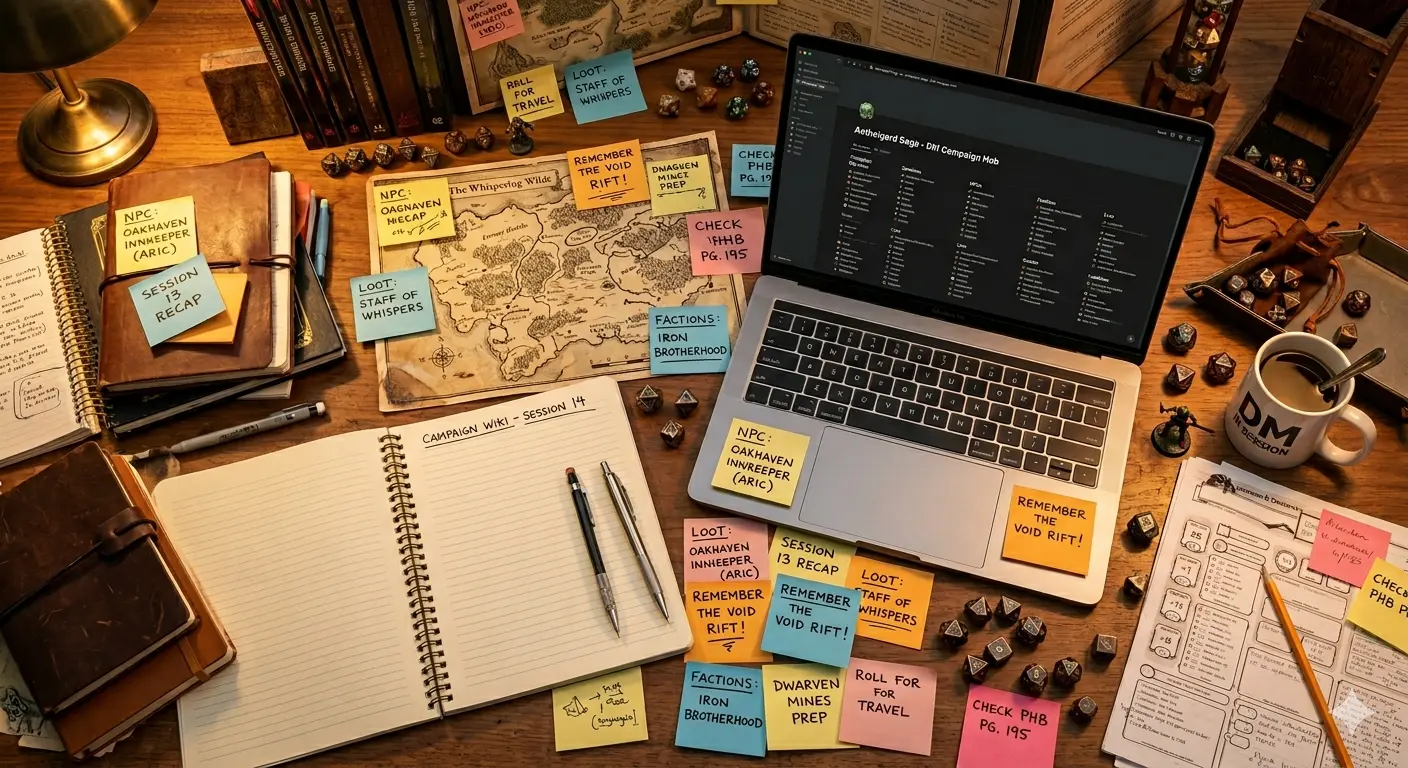
The Lazy DM's Guide to Campaign Wikis (Without Spending 40 Hours in Notion)
You don't need a beautifully architected Notion database that you'll abandon by session five — here's what a campaign wiki actually needs to do, and the two approaches that survive contact with a real campaign.
Let me describe a thing that has happened to me multiple times.
A new campaign is starting. I'm excited. I have lore. I have NPCs with backstories. I have a regional map and a political situation and a secret history of the world that players might never even discover but I know it and it matters.
So I sit down and I build a wiki. I spend a weekend in Notion setting up databases for NPCs, locations, factions, and items. I link everything together. I add properties — relationship status, alignment, plot relevance, alive/dead toggle. I build a campaign timeline. I make a map gallery. It looks incredible. It's the most organized I have ever been in my life.
I use it for four sessions.
Then life happens, or prep gets busy, or I just... don't update it. The living document stops living. The NPCs I introduced in session seven don't make it in. The faction alliance that shifted in session ten never gets recorded. By session fifteen, the wiki is already historical fiction — a portrait of the campaign as it was, not as it is — and every time I look at it I feel guilty instead of helped.
I know I'm not alone in this because I've talked to enough DMs to know this is basically universal. The elaborate campaign wiki is the organizational system we aspire to and the one we almost never actually maintain.
The good news: you don't need to.
What a Campaign Wiki Is Actually For
Before we figure out how to build one that doesn't collapse under its own weight, it's worth asking what we actually need it to do.
Most DMs who start a wiki are trying to solve one of a few problems:
"I keep forgetting my own world." You introduced a city in session two and you can't remember what you named the river that runs through it. An NPC shows up again and you can't remember what their deal was. The party asks about a faction and you have to stall while you mentally reconstruct who they are.
"My players are lost." The campaign has been running long enough that there's real history, and players are starting to lose the thread. Who are we supposed to talk to about the thing? Weren't we looking for something before the dungeon happened?
"I want prep to feel less like starting from scratch." Every session you sit down to prep and you spend the first thirty minutes just reminding yourself where everything is before you can actually create anything new.
All three of these are legitimate problems. But notice that none of them require a beautifully architected relational database with forty custom properties. They require findable information. That's a lower bar, and it's achievable without a Notion PhD.
Why Elaborate Wikis Fail
The fundamental problem with the Notion wiki approach — or any hand-built wiki system — is that maintenance is manual and it competes with prep time.
After every session, you've just run four hours of an improv game where half the things that happened weren't planned. NPCs said things you didn't script. The party went somewhere you didn't expect. New lore got established in the moment that now needs to be canonical.
All of that needs to make it into the wiki. And after a four-hour session, at 11pm, when you're tired and just want to decompress — updating a database is the last thing you want to do.
So you don't. And it falls behind. And then it's embarrassing to open because it's so out of date. And eventually you stop opening it.
The other issue is the setup investment. A weekend spent building a wiki structure is a weekend not spent on literally anything else — prep, rest, the other parts of your life. And if the wiki ends up not being used, that investment just evaporates.
The elaborate wiki is a victim of its own ambition. The more impressive the system, the more impressive the maintenance burden.
What a Useful Campaign Wiki Actually Looks Like
Here's what I've landed on after years of trying different approaches.
A useful campaign wiki has three things: an NPC list, a location list, and a session history. That's it.
NPC list: Name, one-sentence description, current status (alive, dead, unknown, complicated), and last seen. Maybe a note about their relationship to the party. Nothing else unless it matters.
Location list: Name, one-sentence description, and notable facts. "Millhaven — mid-sized river city, ruled by a merchant council, party has allies in the dockside district." Done.
Session history: A short summary of each session. Not a novel — the key events, decisions made, and unresolved threads. Three to five bullet points per session is enough.
With just these three things, you can answer basically any question that comes up at the table. Who was that person? Check the NPC list. Where is that place? Check locations. What did we decide about the cult? Find the session where the cult came up and read the bullet points.
It's not glamorous. It doesn't have graph views or relationship mapping or a dynamic timeline. But it's maintainable, which means it stays accurate, which means it's actually useful.
The Two Approaches That Work
The "Good Enough" Manual Approach
If you want to keep this simple and manual, here's the system that I've seen actually survive contact with a real ongoing campaign:
Keep one document per campaign. Not a database, not a linked wiki — one document. At the top, your NPC list and location list. Below that, a running log of sessions in reverse chronological order (newest at top, so you always open it to the most recent session).
After each session, spend ten minutes adding: one paragraph or a few bullet points about what happened, any new NPCs or locations to add to the lists, and any updates to existing entries (NPC killed, faction relationship changed, etc.).
Ten minutes. Every session. Non-negotiable.
The format doesn't matter. Google Docs works. A Notion page works. Even a long plaintext file works. What matters is the ten-minute habit.
The limit of this approach is search. One long document gets unwieldy around session twenty or thirty when you're scrolling to find something. But by that point you hopefully have enough of the campaign in your head that the document is supplementary, not primary.
The Automated Approach
The other option — the one I obviously think is better, since it's why I built Epicly — is to not maintain the wiki manually at all.
Epicly's Campaign Codex builds itself from your session recordings. Every session you upload gets processed, and the entities in it — NPCs, locations, factions, items, quests — get extracted and added to the Codex automatically. NPCs get updated when new information comes out about them. Session history accumulates on its own.
The thing that sold me on this approach wasn't even the automation itself. It was the compounding effect. By session ten, you have a Codex that has been watching the campaign from the beginning. It knows that the innkeeper who seemed irrelevant in session two turned out to be connected to the thieves' guild in session eight. It has the full arc, not just the current snapshot.
That context is what makes it useful for prep in a way a manual wiki rarely is. When I open the Codex before a session, I'm not just looking at a list of NPCs — I'm looking at a living record of how this particular campaign has evolved, with all of the connections that have formed over time.
And critically: I didn't spend a weekend building it. I didn't spend ten minutes after every session updating it. It just grew alongside the campaign while I was playing the game.
On Sharing the Wiki With Your Players
This is worth addressing because it changes the calculus a bit.
A wiki that's only for the DM is a prep tool. A wiki that players can access is a campaign engagement tool — something that keeps them connected to the world between sessions and reduces the "wait, who was that again?" problem from the player side.
If you want your wiki to be player-facing, a few things matter more:
Clarity over comprehensiveness. Players don't need your DM notes on an NPC's secret motivations. They need the in-world information their characters would actually know. A player-facing wiki should probably have a "what the party knows" framing, not "what is true about the world."
Accessibility. If players have to log into a separate platform they've never used before, half of them won't bother. Discord-formatted recaps that players can actually see in the server they're already in will get more engagement than a perfectly organized Notion database they have to navigate.
Don't share your prep notes. This seems obvious but it's caught DMs before. If your wiki lives in the same place as your DM-only information, be careful about what you're giving players access to.
The Things That Are Definitely Not Worth Your Time
While we're here, a quick list of wiki features that sound great in theory and eat significant hours for minimal actual benefit:
Relationship maps and graphs. I know. They look incredible. "A visual map of NPC relationships!" In practice, they take forever to maintain and you consult them maybe twice per campaign.
Timeline trackers. Unless your campaign's plot is genuinely calendar-dependent (political election coming up, ticking clock), a detailed in-world timeline is prep you'll never use.
Elaborate tagging systems. "I'll tag every NPC by alignment, by faction affiliation, by whether they're a potential ally or enemy, by region, and by importance tier." You will stop tagging things by session five.
World history deep dives. The three-thousand-year history of your empire is great for your own creative process. It is not a wiki entry that needs to be written, formatted, and maintained.
The rule I use: if it doesn't help me answer a question that will come up in the next three sessions, it doesn't go in the wiki right now.
Starting From Nothing
If you're mid-campaign and you have no wiki at all, here's how to start without it being overwhelming:
Don't try to backfill everything. Pick a starting point — today — and start maintaining records from this session forward. Add a note when you reference something from the past that you had to reconstruct from memory ("this is the kind of thing I should have recorded"). Gradually the forward-looking record becomes good enough to carry you.
The backfill temptation is real and it's a trap. You'll spend three hours trying to document sessions one through eight and then be so exhausted you don't document session nine.
Start now. Document forward.
The Bottom Line
A campaign wiki doesn't need to be impressive. It needs to be accurate and findable.
The most elaborate wiki in the world is worthless if it's six sessions out of date. A plain document with current notes is worth more than a beautifully architected system you've stopped maintaining.
Either keep it radically simple and commit to ten minutes of updates after every session, or automate the maintenance entirely so you don't have to think about it.
The goal was never to have a good wiki. The goal is to run a good campaign. The wiki is just a tool for that — and tools that require more upkeep than they deliver value are tools you should replace with something better.
Don't want to maintain a campaign wiki by hand? Epicly builds and updates your Campaign Codex automatically from session recordings — NPCs, locations, factions, and session history, all in one place without the manual work. Free to get started.
More from the Blog

Try Epicly
Ready to stop forgetting your best sessions?
Upload your session audio and Epicly returns a clean recap, living campaign wiki, and an AI that knows your whole story. Free to start.