How to Take D&D Notes Without Breaking Immersion
Every DM has missed a player's reaction because they were scribbling it down. Here's an honest look at every note-taking method — and how to stop letting your system compete with your game.
Here's a scene that will either sound familiar or become familiar very quickly once you start DMing.
You're mid-session. The rogue just made a decision that's going to change the entire campaign — a gut-punch moment you didn't plan. Your players are reacting. The energy is electric.
And you're looking down. Frantically scribbling. Trying to capture enough of the moment that you'll remember it next week, while simultaneously missing the actual moment itself.
Or, (for better or worse, I can't decide), you're caught up living in the moment with them, but then in 3 weeks when you start the next session, NO ONE — DM or players — remembers quite what happened, and no one took notes.
I've been DMing for a long time. And for most of that time, I was a compulsive note-taker. I had notebooks, Google Docs, color-coded Notion databases — the works. I optimized my note-taking system the way some DMs optimize encounter builds.
And then one session, I missed my player's face when their character's backstory finally paid off because I was writing it down.
That was the moment I started rethinking the whole thing.
Why Session Notes Matter (and Why the Standard Advice Doesn't Cut It)
Before we get into methods, let's be honest about what we're actually trying to solve. Session notes aren't really about documentation for documentation's sake. They serve three real purposes:
- You need to remember what happened so you can prep the next session
- Your players need to remember what happened so the story makes sense
- You need a record for when someone asks "wait, didn't we meet this guy before?" at the table
Most advice treats this as a pure information problem. Take better notes, organize them better, use a better app. But the real problem is a presence problem. Every minute you spend writing is a minute you're not running the game.
A note-taking system that captures 70% of the session while keeping you fully present is worth more than one that captures 95% while pulling you out of it constantly.
The Methods, Honestly Reviewed
Let's go through the real options. Not the theoretical ones — the ones actual DMs use.
The Notebook
The classic. Pen and paper, no setup, no apps to learn.
What it's actually like: Great for jotting quick shorthand mid-session (NPC names, locations, initiative order). Terrible for anything you need to find later. Your handwriting gets progressively worse as the session gets more intense. After three hours you'll have notes that look like they were written during an earthquake.
The other problem is archaeology. Six sessions later, trying to find that detail about the merchant's warehouse means flipping through pages of increasingly illegible chicken scratch.
Still — for pure in-the-moment capture, nothing is faster. If you're a notebook person and it works for you, keep using it. Just plan on spending time after the session turning those notes into something readable.
Best for: DMs who type slowly or find screens distracting at the table.
A Doc or Notes App (Notion, Obsidian, Google Docs)
This is where most DMs eventually end up. You type during the session, you have a searchable archive, you can share with players.
What it's actually like: Better than notebooks for retrieval. Still requires active attention during the game. You'll either type too little (and wish you'd written more) or too much (and spend 40 minutes after every session cleaning it up into something coherent).
Notion and Obsidian in particular are really good campaign management tools — organizing your world, tracking NPCs, building a wiki. They're less good as a live session capture tool because they're not designed for it. You end up with half-finished sentences and bullet points that made sense in the moment and read like nonsense a week later.
The other issue: sharing. Even if your notes are great, getting players to actually read a Google Doc before next session is... optimistic.
Best for: DMs who are already comfortable with Notion/Obsidian for campaign organization and want everything in one place. Accept that you'll need cleanup time after every session.
Designated Note-Taker (Outsourcing to a Player)
Ah yes. The classic "someone should take notes" announcement at the start of a session that results in one player writing three bullet points and forgetting about it by hour two.
I've tried this. It doesn't work unless you have one player who genuinely enjoys it — and even then, they're missing the game too.
Best for: Tables with that one player who asks "can I take notes?" and actually means it. You'll know them when you find them.
Recording the Session (Audio)
This is where things get interesting.
Record your session — Discord makes this trivially easy with a bot like Craig.chat, or you can just use your phone on the table for in-person games — and you have a complete record of everything. Nothing missed. No shorthand to decode later.
The catch: A four-hour session produces four hours of audio. You are not going back and listening to that. The raw recording itself isn't useful — it's the starting material for something useful.
If you're willing to spend 30–60 minutes post-session pulling out the key moments, this is actually a solid approach. But most of us aren't. We just finished running a game at midnight and we want to go to sleep.
Best for: DMs who process information well by listening, or who want a complete archive they might reference occasionally.
Automated Session Summaries
This is what I landed on after years of trying everything else, and honestly what I built Epicly to solve for myself.
The idea: record your session, upload the audio, and get a structured summary back. Transcription of who said what, plus an AI-generated recap that pulls out the actual story beats — key events, NPC interactions, decisions made, plot threads that moved.
What I wanted was something that let me be completely present during the game and handle the documentation work after, automatically. Not a transcript (still too much to read through), but an actual summary I could use for prep and share with players.
The difference this makes to immersion is hard to overstate. When I'm not worried about capturing the session, I'm actually watching my players. I'm noticing when something lands. I'm reacting to the room instead of my notepad.
And the recap that comes out the other side is better than anything I would have written myself — partly because it caught things I would have missed, plus it saved me an hour of time (priceless).
Best for: DMs who want to be present during the game and not spend time on post-session documentation. Which, honestly, should be most of us.
The System I Actually Use Now
For what it's worth, here's my current setup:
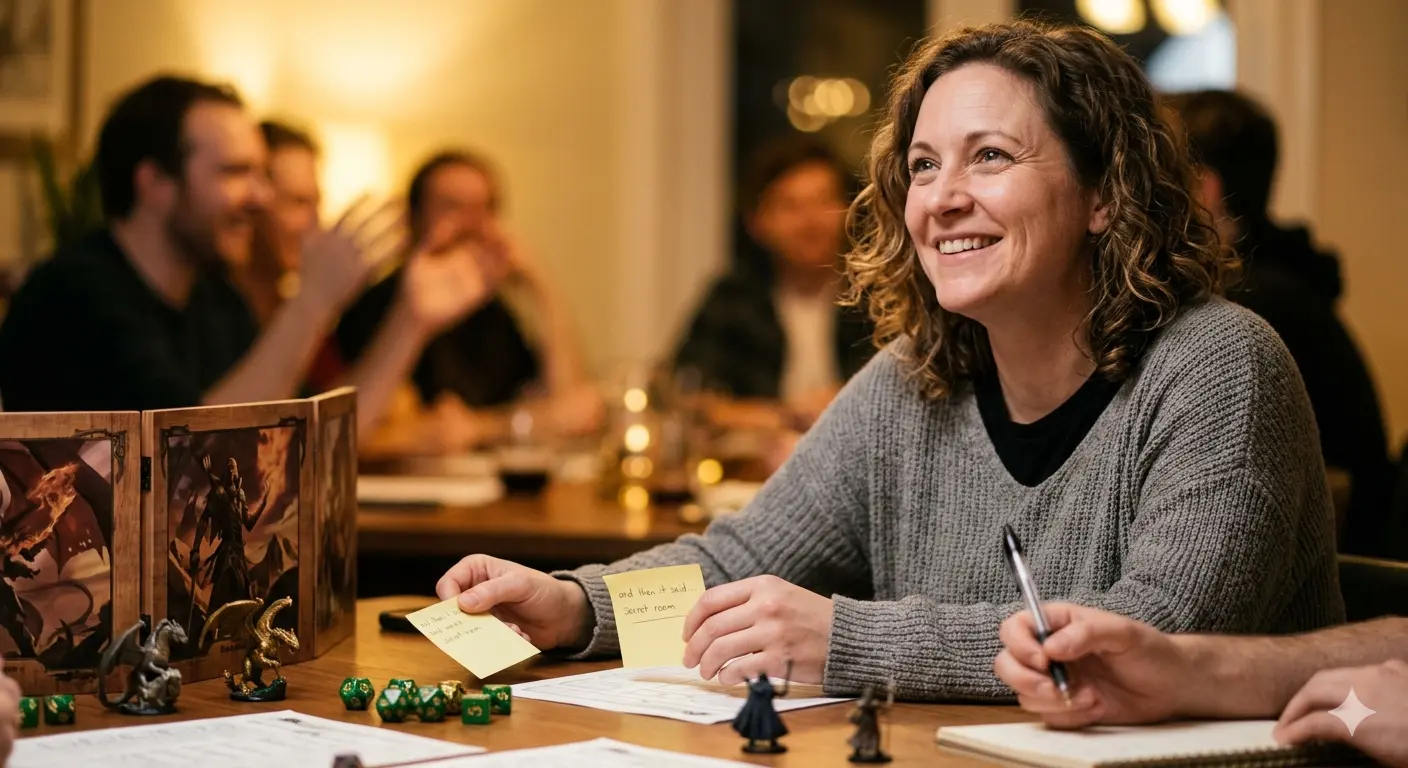
During the session: I keep a sticky note next to me for genuinely critical things I don't want to miss — things like a player's improvised character decision that I want to honor in the next session, or a plot thread I need to remember to follow up on. Maybe five words max. I'm not trying to capture the session; I'm flagging things that need my attention.
After the session: Upload the recording to Epicly, and go to bed (no hours spent documenting). In the morning I check and have a recap I can read in five minutes. I share it in our group Discord before the next session. Players actually read it because it's short and entertaining.
For prep: The recap is my starting point. What did players seem excited about? What threads are dangling? What did I promise that I need to follow through on? Fifteen minutes of reading the summary and I know exactly what to prep.
The whole post-session workflow takes about ten minutes of actual effort. Compare that to the hour I used to spend organizing notes into something coherent, and the game prep that required me to remember things I'd half-forgotten.
A Few Notes on Sharing Recaps With Players
Whatever system you use, the format matters a lot for whether players actually engage.
Long Google Docs: Nobody reads them. You write a 1,200-word recap in third-person narrative prose, drop it in the Discord, and it gets two reactions. One from the player who always reacts to things and one fire emoji from someone who was already asleep.
Short, punchy, Discord-formatted recaps: Players engage. Two or three paragraphs. Written in a voice that sounds like the story you're actually telling. Posted in the session notes channel right after game night so it's there when people wake up the next morning.
This sounds basic but it's genuinely the difference between a group that's engaged with the campaign narrative between sessions and one that arrives each week having forgotten most of what happened.
The Bottom Line
There is no perfect note-taking system that works for every DM. But there's a useful filter: how much of your presence is this method costing you during the session?
If your current system keeps you looking down during your players' best moments, it's worth rethinking regardless of how well-organized the output is.
The job of a DM is to run a good game. The job of your note-taking system is to support that — not compete with it.
Whatever method you use, make sure the tool is serving the game. Not the other way around.
Running a weekly campaign and tired of spending Sunday afternoon writing up what happened Saturday night? Epicly handles the recap and notes automatically — upload your session audio and get a shareable summary (and living campaign world wiki) that your players will actually read. Free to use.
More from the Blog
Try Epicly
Ready to stop forgetting your best sessions?
Upload your session audio and Epicly returns a clean recap, living campaign wiki, and an AI that knows your whole story. Free to start.