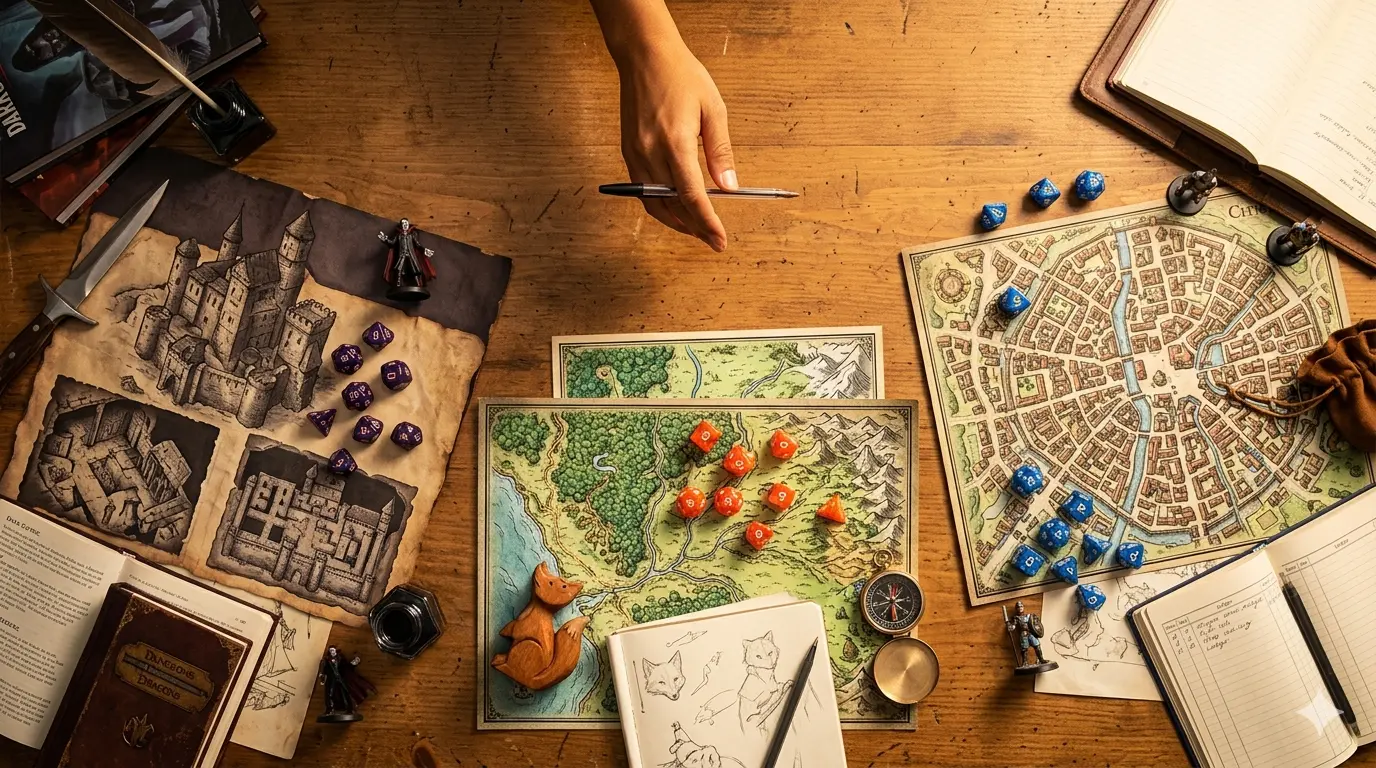
How to Run Multiple D&D Campaigns Without Losing Your Mind
Running two (or three) campaigns at once is how most dedicated DMs eventually end up — here's how to keep the stories, NPCs, and plot threads from bleeding into each other.
It starts innocently enough.
You're already running a campaign on Saturday nights. It's going well. Then a friend group you've known for years finally decides they want to try D&D, and they ask if you'll run it. Of course you say yes. You love this stuff. How hard could it be to run two games?
Then someone from your Saturday group wants to run a one-shot for their birthday. And you offered to cover for a friend who DMs a third table while they're on vacation. And now it's Thursday and you're staring at your notes trying to remember which campaign has the thieves' guild, which one has the thieves' guild and the political intrigue, and which one has the character named Mira who is a villain in one game and a beloved party NPC in another.
This is the multi-campaign problem. And if you DM for long enough, you will eventually live inside it.
Who Actually Runs Multiple Campaigns
Before we get into the how, let's talk about who this actually affects — because it's more common than people admit.
The obvious case is the dedicated DM who runs for multiple friend groups. Maybe you have your "main" long-term campaign and a shorter rotating group for people whose schedules don't line up with the main table. Maybe you picked up a second game because your partner's friends wanted to try D&D and you were the only person anyone knew who could run it.
But there's also the "technically one campaign" version that still creates the same problems. You're running a campaign that's been going for two years. You have thirty-plus sessions of history. You've introduced dozens of NPCs, multiple factions with overlapping agendas, plot threads you planted in session four that you're finally paying off now. Keeping that volume of story straight is its own kind of multi-campaign chaos, even when there's only one table.
And then there's the professional or semi-professional DM who runs for four or five groups because they enjoy it or it's a side income. Those people have earned their organizational systems.
Whatever your situation, the core problem is the same: more story than you can hold in your head at once.
The Things That Actually Go Wrong
Most advice about running multiple campaigns focuses on scheduling and prep time management. Both matter, but in my experience, they're not the most painful failure modes. The real problems are subtler.
Cross-contamination
This is the Gerald problem I described in the intro. You introduce an NPC name in one campaign, use it again in another without realizing, and now you have two unrelated Isaacs or two cities named Port Valen and you didn't do it intentionally.
For place names and NPC names, this is annoying but manageable. The worse version is when you cross-contaminate plot elements. You had a great idea in one campaign — a spy who was actually reporting to the party's patron all along — and without realizing it, you start seeding the same story beat in the second campaign because your brain has decided it's a good idea. It is a good idea. You already used it.
Players don't cross tables. They won't know. But you will, and it makes the campaigns feel less distinct and less like they're responding to their specific players.
Forgetting what the party actually knows
This one causes more table problems than anything else. Each campaign has its own information state — what the players have discovered, what clues they've followed, what conclusions they've drawn. When you're running multiple games, keeping those information states separate is genuinely hard.
The failure mode looks like this: you accidentally hint at something in Campaign B that the party has only uncovered in Campaign A. Or you give Campaign B's party a knowing reaction to a revelation that's supposed to feel new, because in Campaign A it stopped being surprising two sessions ago.
Mid-session memory blanks
You're running Session 18 of your Tuesday campaign. A player asks a question about something that happened in Session 12. You know it happened — you were there — but you cannot remember the specific detail right now, at the table, with four people looking at you.
This happens in single campaigns. It happens constantly in multiple campaigns. And it breaks immersion in a way that's hard to recover from, because the DM forgetting what happened in their own story is exactly the kind of thing that makes players feel like the world isn't real.
The prep debt spiral
Every session you run generates story that needs to be incorporated into future prep. One campaign's prep debt is manageable. Two campaigns' worth compounds fast. You prep for Saturday, run Saturday, then immediately need to prep for Tuesday without having fully processed what happened Saturday — and somewhere in there you're supposed to have a life.
What Actually Helps
Give each campaign a distinct identity — on purpose
The more different your campaigns feel from each other, the less you'll accidentally blend them. This is more intentional than it sounds.
If you're running two fantasy campaigns simultaneously, make deliberate choices that separate them: different tone (one serious, one comedic), different system or era (high magic vs. low magic, medieval vs. Renaissance), different structural approach (one is player-driven sandbox, one is a tight narrative arc). The more they live in separate mental neighborhoods, the less they'll contaminate each other.
Where possible, differentiate your NPCs visually in your notes. I use different colored index cards for different campaigns when I'm doing physical prep. It sounds trivial and it actually helps.
A separate campaign bible for each game. Seriously, separate.
This is non-negotiable. If you are keeping notes for multiple campaigns in the same document, folder, or notebook, you are making your own life harder for no reason. Every campaign gets its own space, and you don't mix them.
This applies to physical notes, digital notes, everything. Label everything obsessively. "Tuesday campaign" and "Saturday campaign" isn't enough — use the actual campaign name so there's zero chance of confusion at a glance.
Stop trying to remember everything. Start writing it down faster.
Single-campaign DMs can get away with relying on memory more than they should. Multi-campaign DMs cannot. If something happens at the table that matters — a decision the party made, a detail about an NPC you improvised, a plot thread you introduced — it needs to live somewhere outside your head before the session ends.
Not a novel. A bullet point. "Mira revealed she works for the council — party doesn't fully trust her yet." Twenty words that will save you from spending ten minutes trying to reconstruct this detail at the start of the next session.
The problem is doing this consistently, at the end of every session, when you're tired and just ran four hours of a game. I'll be honest: I was bad at this for years. The workaround I eventually landed on was recording sessions and letting the transcription do the capture work for me — more on this in a minute.
Pre-session review is not optional
Before every session, read your notes from the last session of that campaign. Not all your campaigns — just that one. It sounds obvious and a surprising number of DMs skip it when they're busy.
The goal of this review is not to prep the entire session. It's to re-enter the mental state of that specific campaign — the voice of the world, the status of the party, what they care about right now, what's hanging in the air. Ten to fifteen minutes of this before game night makes a noticeable difference in how present you feel when the session starts.
Use the gap between sessions deliberately
When you're running multiple campaigns, the time between sessions is doing a lot of work. Campaign A's session on Saturday means you have a week until Campaign B's session on Tuesday — which gives you a mental gap to switch contexts. Use it.
I've found it helps to do a lightweight "close" of Campaign A right after I run it: a quick note about what happened, what I need to prep, what I'm thinking. Then I don't think about it again until the day before the next session. This sounds like willpower but it's more about clearing the buffer — you can't context-switch well if you're still mentally chewing on the last campaign.
The Part Where Campaign Management Tools Actually Matter
I generally try to keep my tool recommendations practical — use what works, don't over-engineer it, simpler is usually better.
But multiple campaigns are genuinely the use case where purpose-built campaign management tools justify themselves, in a way they might not for a single long-running game.
The reason is surface area. One campaign's notes are manageable in Notion or a notebook. Two campaigns' notes are manageable with effort and discipline. Three campaigns' notes, each with their own NPCs and locations and plot threads and session history, are a serious organizational problem that grows every week.
This is exactly why I built the Campaign Codex feature in Epicly — and why I personally find it most useful when I'm running more than one game simultaneously. Each campaign gets its own Codex: a separate wiki that's been building itself from the session recordings, tracking NPCs and locations and factions automatically, keeping a history of what happened in every session.
Before a Tuesday session, I open Tuesday's campaign. The Codex is there. The NPC list is there. The session history is there. I'm not sifting through a shared document trying to remember which entries belong to which game. Everything is scoped to that campaign, and nothing from Saturday bleeds in.
The Lorekeeper chat — the AI that knows the campaign history — is also genuinely useful in this context. Being able to ask "what does the party currently know about the Merchant Guild?" and get an accurate answer from the actual session history, rather than trying to reconstruct it from memory, is the kind of thing that's nice to have for one campaign and borderline necessary when you're managing three.
The Honest Advice Nobody Gives
Here's the thing nobody says about running multiple campaigns: there's a limit, and you should know what yours is before you hit it.
Running two campaigns simultaneously is manageable for most DMs who are reasonably organized. Running three is possible but costs real mental energy. Running four or more is a job, and you should either be getting paid or deeply, intrinsically love the craft of DMing in a way that makes the overhead feel worth it.
The mistake most DMs make is saying yes to another table because they love D&D, not because they've honestly assessed whether they have the bandwidth to run it well. A half-present DM who's mentally exhausted by the third campaign of the week is not giving any of their players the game they deserve.
It's okay to say no to running another game. It's okay to wrap up a campaign that's run its course so you can start something new rather than maintaining three simultaneously. It's okay to hand off DMing duties to a player who wants to try it.
The goal is to run great sessions at every table you're committed to. Everything else is just a question of how much you can sustainably take on.
The Short Version
If you're going to run multiple campaigns:
- Make each campaign deliberately distinct from the others
- Keep completely separate notes for each game, no exceptions
- Stop relying on memory for things that should be written down
- Do a pre-session review before every game, every time
- Use the gap between sessions to actually switch contexts
- Be honest with yourself about how many games you can run well
And if you find yourself confusing your NPCs, forgetting what the party knows, or showing up to sessions without a clear sense of where the story is — that's not a character flaw. It's an organizational problem. Those are solvable.
Running more than one campaign and spending too much time on post-session cleanup? Epicly keeps each campaign's history, NPCs, and recaps completely separate — so your Tuesday table never bleeds into your Saturday table. Free to get started.
More from the Blog
Try Epicly
Ready to stop forgetting your best sessions?
Upload your session audio and Epicly returns a clean recap, living campaign wiki, and an AI that knows your whole story. Free to start.